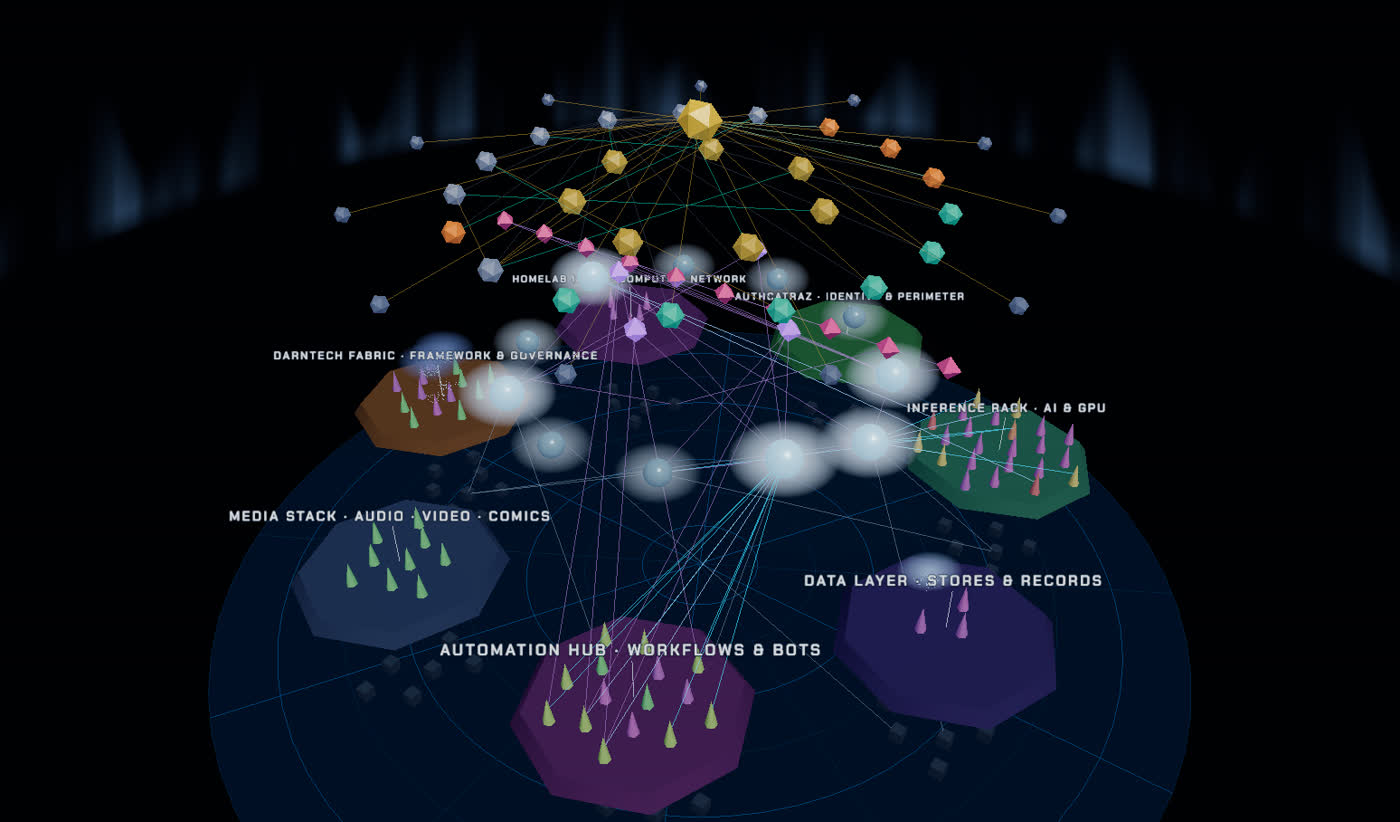
Field guide — reading the WhetherMap
One rule organizes the whole scene: altitude is abstraction order,
ascending. What sits above a region, at any altitude, belongs to it.
This is the real shape and scale of a working system — every node and edge
is regenerated nightly from the live registry that runs the place, never
hand-drawn. The regions, the capability cores, and the substrate stack
carry their real names. Individual products are anonymized by
design: the spires show where each product stands and what it is built
from, without naming client work or unreleased builds. The three named
marks — Corîolîî, Oolitic, Oolitic Engine — are
public brands.
Stratosphere — who runs it
The top stratum is the operating org itself: one operator at the apex, a
ring of standing personas, then the services, seats and thread-agents that
do the work, and an outer ring of workstreams. Solid gold lines are
reporting lines; the faint slate ones are dotted-line oversight. Turn on
agent links and you can see the tethers drop out of the stratosphere
onto the individual products below — who actually owns what. Every label
here is a role: what that part of the org does, not what it is
called. The structure, the counts and the reporting lines are real and
regenerate nightly; the identities behind them are withheld, because an org
chart of a working practice names people and client engagements. One person
operating with the leverage of a team is what the shape is showing.
Jetstream — how it's governed
The station spine rides above the weather because governance shapes which
cores form and graduate — the Whether in WhetherMap. Read it left to
right from the governance root through the three-stage cascade —
build, verify, consolidate — that every unit of work passes through, with
the supporting registers (deployments, work ledger, issue tracking,
published method) alongside. Roles again, not names.
Weather — the core abstractions
Each cell is a shared capability core — retrieval (RAG), vision,
audio/speech, deployment, domain-expertise, game-runtime and friends: a
clean, reusable abstraction extracted once and instantiated by many
products. instance-of (cyan) rains down from a core onto the
products built from it — the repeatable-unit story, and the reason the
estate compounds instead of sprawling.
Solid, bright cells are built and in service; faint cells are still
forming. Count them — that ratio is the honest state of the estate, not a
claim we maintain separately from the map. Which core is which stays
unlabelled here; how many are real does not.
Recipes — cores composed across domains
The gems on the inner ring above the weather are service recipes:
blueprints for a deliverable service assembled from several of the shared
cores at once. Follow a gem's links and you can read what it is made of —
the same underlying cores recur beneath services as different as
photo-documented service records and repair-shop job tracking. That
recurrence is the point: the cores are not one product's internals, they
are a kit that recombines across domains, and the recipes are where the
recombination shows on the map instead of being asserted in prose.
Regions and spires — the products
Seven regions of real terrain — identity & perimeter, AI & GPU,
data, automation, media, framework & governance, homelab
infrastructure — each carrying its products as spires (hue = product
family). A product's grounds-on relation is encoded by
placement — it stands on its region, so no line is drawn.
Rain — live work-weather
The map reports its own weather: rain falls over the spires where
engineering work actually landed in the last 24 hours — the harder it
rains, the more happened there. A red-tinted, pulsing cloud is a
stationary front: a standing hard constraint parked over that
system. The counts in the corner are live; systems are matched to spires
by the same deterministic transform that builds the map, so quiet spires
are genuinely quiet.
Aurora — the live GPU
The curtain high over the map is one real graphics card, on-premises, read
live: the estate's own GPU. Its hue is what the card is doing right
now — green for generating methods, amber for rendering game assets,
red when two workloads want the card at once, dim slate when it is idle —
and its brightness is how much of the card's memory is in use. The
numbers in the corner are the real reading, rounded to whole tenths of a
gibibyte. The feed is deliberately coarse: a workload class and a
memory figure, never a process, a path, a model name or a customer. When
the card can't be read, the aurora goes out and the corner says so rather
than showing a number nobody measured.
Aquifer — the substrates
The boxes underground are the third-party substrates the estate actually
runs — Postgres, Redis, ollama, ComfyUI, n8n, Plex, headscale and ~40
more — each sitting beneath the region that consumes it. Perimeter
services are labeled by role (SSO gateway, credential vault) rather than
by product. The perimeter edges toggle shows which cores draw on
which substrate.
Lightning — what stands on what
Hover (or tap to pin) any ground-level element — a substrate box or a
region plate — and lightning repeatedly strikes up through everything that
stands on it.
How the nightly refresh actually works
Nothing on this page is drawn by hand, and nothing is drawn on demand
either. Overnight, a chain of small single-purpose jobs runs in sequence —
each one owns exactly one feed, rebuilds it from the live registry, and
publishes it. They are deliberately separate processes: a job that fails
takes down its own feed and nothing else, and it fails loudly where it
happens instead of quietly degrading everything downstream.
Each generator is deterministic. Run it twice against unchanged
inputs and you get a byte-identical file. That sounds like a detail and it
is most of why the refresh can be trusted: when a feed does change,
the change is real, so "this is different today" is a signal rather than
noise. A separate checker closes the loop — it rebuilds every feed from
scratch and compares three copies against each other: the one it just
built, the one this page is actually serving, and the mirror. Disagreement
is a failure, not a warning.
The map also photographs itself every night, so there is a running record
of how the system's shape changes over time and not just how it looks
today. And when a feed genuinely can't be read, the surface that depends on
it says so — the aurora goes out, the corner reports the gap — rather than
holding up yesterday's number as though it were current.
Two maps, not one filtered map
This is the public map. There is an internal one, and the difference
between them is the part worth stealing.
The obvious way to publish an internal system map is to take the internal
one and filter the sensitive things out. That approach fails the way every
blocklist fails: it is correct about everything you remembered and silent
about the one you didn't, and the cost of being wrong once is that a name
ships.
So this map is not a filtered copy. It is a second artifact, built by a
renderer that never had the private data to begin with. There are no
name-keyed exceptions anywhere in it — nothing in this page knows a private
name well enough to hide it, because the join that would have introduced
one happens further upstream, and the feed this page reads was generated
without it. A leak here isn't caught by a filter; it is structurally
unavailable.
Two more gates sit on top of that, and both fail closed. The first is
reachability: the public surface is denied by default, and a short,
hand-maintained manifest of exact paths is the only thing reachable at all.
A file nobody remembered to list doesn't leak — it simply isn't there. The
second is content: every listed file is scanned by category before
it ships, and a match refuses the deploy instead of warning about it. The
categories are generic words rather than remembered literals, because a
gate that stores the secret it is protecting has itself become the leak.
Then it gets checked again from the outside. A separate job re-walks the
whole public surface every night as an anonymous visitor with no
credentials, and anything reachable that isn't on the manifest is a
finding. Checking your own work from inside the perimeter is not checking
your own work.
About this view. Regenerated nightly from live data
by a deterministic transform — never hand-edited. Shape, scale, the layer
system, and the region / core / substrate names are real. Individual
products are pseudonymized, except the marks we show on purpose:
Corîolîî, Oolitic, and the Oolitic Engine.
The rain is measured, not decorative — it comes from the same activity
telemetry that runs the estate, and the corner chip timestamps exactly how
fresh it is. Show, don't tell.
Where this runs. The source for this page lives in version control
and ships from there. The renderer library and the label typefaces are
served from the same machine as the page — and the deploy refuses to ship
at all if the typefaces are missing, rather than let a system font quietly
stand in for them. That machine is a computer in a house, on a home
connection, with nothing standing behind it: when the power or the line
goes, so does this. That's the real cost of self-hosting, and it belongs
here rather than in the moment you find it out.