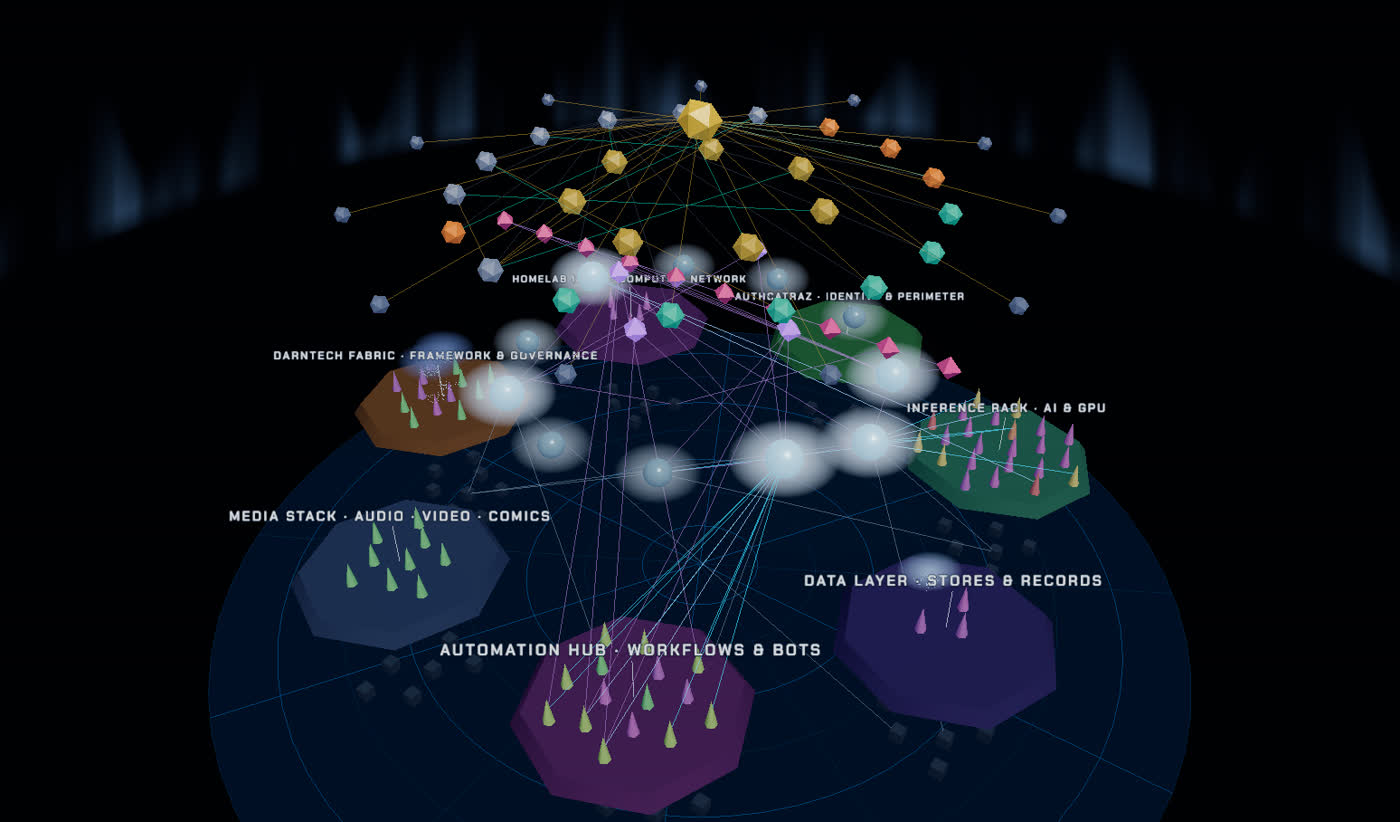
Field guide — reading the WhetherMap
One rule organizes the scene: altitude is abstraction order. What
sits above a region belongs to it. Every node and edge is rebuilt nightly
from the live registry, never hand-drawn. Regions, capability cores and
substrates carry their real names. Individual products are anonymized,
except the public marks Corîolîî, Oolitic and
Oolitic Engine.
Stratosphere — who runs it
The operating org: one operator at the top, then the roles that do the
work. Labels are roles, not names. Turn on agent links to see who
owns which product.
Jetstream — how it's governed
The governance spine: every change gets a second, independent check
before it lands.
Weather — the core abstractions
Each cell is a shared capability core: retrieval, vision, speech,
deployment and more. Cyan lines rain down onto the products built from it.
Bright cells are in service; faint ones are still forming.
Recipes — cores composed across domains
The gems above the weather are service recipes: one deliverable service
built from several cores at once.
Regions and spires — the products
Seven regions of terrain, each carrying its products as spires.
Rain — live work-weather
Rain falls where work landed in the last 24 hours. A red, pulsing cloud
marks a standing hard constraint.
Aurora — the live GPU
The curtain overhead is one real graphics card, read live: hue shows what
it is doing, brightness how much memory is in use. If the card can't be
read, the aurora goes out.
Aquifer — the substrates
The boxes underground are the third-party software the estate runs:
Postgres, Redis, ollama and about 40 more.
Lightning — what stands on what
Hover or tap any ground element, and lightning strikes up through
everything that stands on it.
About this view. Rebuilt nightly from live data by
a deterministic transform, never hand-edited. Shape, scale, layers and the
region, core and substrate names are real; products are pseudonymized
except the marks above. Each feed is rebuilt overnight by its own job, and
when one can't be read, the page says so instead of showing an old number.
Where this runs. A computer in a house, on a home connection: when
the power or the line goes, so does this map. That's the real cost of
self-hosting, and it belongs here rather than in the moment you find it
out.